
RNG · RTP · HOUSE EDGE
How Online Casinos Work
The machinery behind a UK-licensed casino game, in plain English and with the arithmetic left in. No system, no strategy, no promises.
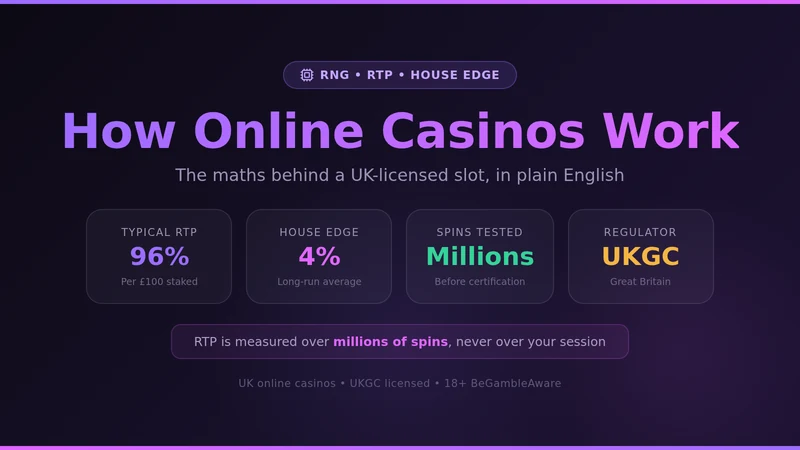
A UK online casino licenses games from studios, runs them through a certified random number generator, and keeps a fixed mathematical margin on every round. The UK Gambling Commission licenses the operator and can audit the maths. Nothing adapts to you, and nothing owes you a win.
That is the honest one-paragraph version. What follows is the same thing with numbers attached, because the numbers are the part that changes how you think about a session.
A worked example, with real numbers
Take Gates of Olympus at 96.5% RTP, staked at £0.50 a spin. You play for an hour at a typical 600 spins an hour. That is £300 through the machine.
The expected cost of that hour is 3.5% of £300, which is £10.50. Not £10.50 of your £50 balance vanishing at a steady rate — that is the average across an enormous number of players doing exactly the same thing. Your actual result will be nothing like it.
Here is the part people underestimate. On a high-volatility slot, the most likely single outcome of 600 spins is that you finish down between £30 and £60, and a small minority of sessions finish up several hundred. The average is £10.50 because a handful of huge results drag it up. The typical session is considerably worse than the average, and that gap is not a flaw in the game — it is the design.
- Staked in an hour£300600 spins at 50p
- House keeps3.5%Long-run average
- Expected cost£10.50Per hour, on average
- Typical resultWorseMedian < mean
Move the sliders
Change the stake, the RTP and the length of the session, and watch what the maths says. Nothing here is a prediction of your night — it is the average across a very large number of identical sessions.
Total staked
£300.00
Expected loss
£10.50
Cost per hour
£10.50
Cost per hour assumes 600 spins an hour, roughly what an unhurried session on autoplay produces.
Myths that will not die
"It's due a payout"
The generator has no memory. A slot cold for three hours has identical odds on the next spin to one that just paid 5,000x. Anything else would be a defect, not a feature.
"It tightens when you win"
The game runs on the provider's servers with certified maths. The operator cannot reach in and alter it per account — and doing so would end its UKGC licence.
"Bigger stakes pay more often"
Hit frequency and RTP are the same at 10p as at £2. Only the size of the swing changes — which means the losses scale exactly as fast as the wins.
"Playing at 3am is better"
Time of day changes nothing. It is a hangover from land-based folklore about busy floors, and it never applied online in the first place.
"Demo mode pays better than real"
Same game, same certified maths. What differs is memory: a good demo session is memorable, a hundred forgettable ones are not.
"A staking system beats the edge"
Martingale and its cousins redistribute when you lose, never how much. The edge applies to every pound staked regardless of the order you stake them in.
The four words that matter
RNG
Random number generator. Picks each outcome independently, tested by an accredited house such as eCOGRA or GLI before the game is allowed on a UK site.
RTP
Return to player. The share of total stakes a game gives back over its whole lifetime — millions of spins, not yours. Published per game, usually 94–97%.
House edge
The other side of RTP. A 96% game has a 4% edge. It is the price of playing, and it is charged on turnover rather than on your balance.
Volatility
How lumpy the returns are. Two games can share a 96% RTP and feel completely different: one pays small and often, the other pays almost never and then enormously.
Why any of this matters to you
Because it reframes the question. If the edge is charged on turnover, then the thing that decides what a session costs is not luck — it is how much you put through the machine. Stake size, spin speed and session length are the three dials you actually control, and they set the bill more reliably than anything else.
It also kills the idea of chasing. A losing run does not build up credit. There is no point at which the game owes you, so playing on to "get it back" simply buys more turnover at the same 4%.
And it explains bonus terms. When a free spins offer asks for 10x wagering, it is asking for turnover — and turnover is exactly what the edge feeds on. That is why a big bonus with a big multiple is often worth less than a small cash prize from a tournament.
Does it differ between brands?
Barely. The same studios supply the same games to every UK-licensed site, so the maths travels with the game rather than the brand.
| Brand | Regulator | Typical slot RTP | Best table RTP |
|---|---|---|---|
| PartyCasino | UKGC | 94–97% | 99.6% |
| Ladbrokes | UKGC | 94–97% | 99.5% |
| Coral | UKGC | 94–97% | 99.5% |
| bet365 | UKGC | 94–97% | 99.6% |
| Sky Vegas | UKGC | 94–97% | 99.5% |
Swipe the table sideways
Where brands genuinely differ is in the wrapper: bonus terms, withdrawal speed, deposit limits, how quickly support answers. Those are worth comparing. The RTP of Book of Dead is not — it is the same number wherever you open it.
Who this is not for
Worth being blunt, because most pages on this subject are not.
- Anyone looking for income. A negative-expectation game cannot produce one, however it is played.
- Anyone recovering money already lost. Chasing is the single most expensive habit in gambling.
- Anyone staking money they need for something else. The edge does not care what the money was for.
- Anyone who cannot stop when the limit is hit. Deposit limits and GAMSTOP exist for exactly this.
If any of those describe the last few weeks, the useful next step is not another page about RTP. GamCare and BeGambleAware are linked at the foot of every page on this site.
FAQ
How do online casinos work in the UK?
A UK online casino licenses games from studios such as Pragmatic Play and NetEnt, runs them through a certified random number generator, and takes a fixed mathematical margin on every round. The UK Gambling Commission licenses the operator, sets the player-protection rules and can audit the game maths.
What does 96% RTP actually mean?
It means the game returns about £96 for every £100 staked, measured across millions of spins by an independent testing house. It says nothing about your session. Over a hundred spins the outcome can land anywhere from zero to several hundred times your stake.
Are online slots random or fixed?
Random, within fixed odds. A random number generator picks each outcome independently, and the pay table plus the symbol weighting decide the long-run return. The game cannot be tuned mid-session to react to your balance, your bet size or how long you have played.
Does a slot pay out more after a long losing run?
No. Each spin is independent of every spin before it. A slot that has paid nothing for two hours has exactly the same odds on the next spin as one that just paid a jackpot — the machine has no memory.
Who regulates online casinos in the UK?
The UK Gambling Commission. It licenses every operator taking bets from Great Britain, sets rules on advertising, deposit limits, stake caps and identity checks, and runs GAMSTOP as the national self-exclusion scheme.
Is the house edge the same on every game?
No. It ranges from about 0.4% on classic blackjack played correctly to 5-7% on slot side bets and some jackpot games. The lower the edge, the slower your money disappears — that is the only guarantee any of it offers.
Keep reading
Next step
Set the stake, the pace and the stop before you start
Those three dials decide what a session costs. Deposit limits are in the account settings from day one.